Why a Clear Walking Line Can Change a Balcony
A clear walking line on a balcony makes everyday use feel less cramped. Learn how to arrange furniture and pots around the way you use the space.
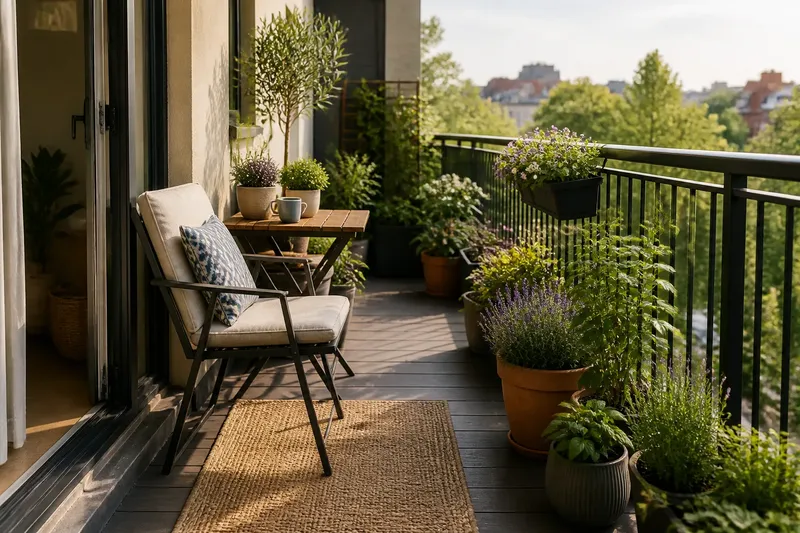
Where should furniture and pots go if your balcony feels cramped as soon as you step outside? A clear walking line on a balcony starts with the way you use the space, not with a stripe down the middle. Think about where you set down a mug, tend a plant or turn to sit; those small actions reveal what the layout needs to support.
The route can curve around a chair or follow the railing. What matters is that the space has a readable arrangement: a place to move, a place to sit and enough room for objects to be used as intended. Start with the main activity, then decide which pieces belong nearby and which are only taking up useful floor.
Choose a route that supports the balcony’s main use
Begin at the threshold and consider what you came outside to do. If the balcony is mainly for sitting, make the chair easy to reach. If you water plants often, keep the pots you tend together where you can reach them without weaving around furniture. A washing line, storage box or small table may call for a different arrangement.
There is no need to force a straight path where the balcony’s shape does not offer one. A route along the railing may suit a long, narrow space; a small recess might take a table without disturbing the seating area. Treat the floor as a set of useful zones rather than trying to make every object line up.
It is not worth rearranging every pot to create a geometric pattern. If the arrangement is easy to use and leaves a clear place for the balcony’s main activity, symmetry is a lesser concern.
Give the doorway a useful landing area
The door needs room to open, and the threshold needs somewhere to step. With a hinged door, notice where its edge and handle travel. With a sliding door, leave the part used for entry accessible. A pot or table right beside the opening may look tidy yet make it awkward to carry a cup outside or bring a watering can back in.
Use painter’s tape or a piece of string to mark the hinged door’s movement on the floor. For a sliding door, mark the section where you step through and leave a clear patch beside it. Keep the marker in place while you arrange other objects, then remove it once you have settled the layout.
Include the room just inside the door in your thinking if the door opens inward. A chair that does not obstruct the balcony may still make the approach from indoors feel cramped.
Arrange furniture for the way it is used
A compact chair can take up little floor space when empty but need more room when someone sits down or stands up. A folding table changes shape when opened. Place each item in its working position before deciding whether it fits, and consider whether you can reach the seat without moving the table first.
Where the floor is limited, grouping furniture to one side can leave a more useful open area than scattering small pieces around the balcony. A chair beside the railing and a table tucked alongside it may create a distinct sitting spot. Keep the seat comfortable to approach; an open patch that makes sitting awkward is not a useful trade.
Folding and nesting furniture can help if you regularly switch between activities. But it is not worth buying a special piece just to save a little floor if setting it up becomes a nuisance. Choose a movable item only when its folded or stored position has a clear place.
Group pots where they are easy to tend
Several small pots placed at the entrance, beside the chair and along the railing can make the floor feel fragmented. Grouping plants in a corner or along one edge gives them a more coherent place and can leave the rest of the balcony easier to use.
Allow for leaves that spread beyond the rim and for the room needed to water without knocking into a chair. Consider how you will reach the plants as they grow, and avoid placing a heavy pot where you would have to shift it often. If a cluster blocks access to another activity, move a pot or reduce the group rather than adding more furniture to compensate.
What questions help settle a balcony layout?
Should the open area run through the middle?
Not necessarily. A strip beside a wall or railing can work just as well if it leaves the seating and planting areas accessible. Put the open area where it supports your usual activities, rather than treating the centre as the only possible route.
Can a chair sit close to the doorway?
It can, if the door still opens freely and there is a comfortable place to step through. Check the chair in its usual position and again when someone is sitting down or getting up.
What if the balcony has an awkward shape?
Use the shape to define separate areas. A recess can hold a table, while a corner may suit a compact group of pots; leave any projecting section open if it makes the space easier to use. A gentle change in direction is often more useful than forcing furniture into a straight row.
How can I tell if a layout is too crowded?
Look for repeated shuffling: a chair that must be moved to reach the table, pots that prevent you from tending other plants, or a door that catches on furniture. If one object keeps interrupting an activity, move it or remove it temporarily and see whether the space works better.
Settle the layout with a simple floor plan
Use cardboard, folded newspaper or painter’s tape to mark where the furniture will sit. Mark the door’s opening area, the chair in use and the table when it is open. Then make one change at a time, so you can see which placement makes the space easier to use.
- Check the doorway: Open the door fully or mark the sliding entrance. If its movement or opening is obstructed, move the nearest pot or chair; otherwise, keep that position under consideration.
- Check the main activity: Mark the chair, table or plant group you use most. If it is difficult to reach or use, bring it closer to the entrance or move a competing object; otherwise, retain its place.
- Check the chair in use: Pull it out or sit down and stand up. If the chair collides with a table or blocks access to another area, turn it or shift it; otherwise, keep the arrangement.
- Check the table open: Expand the folding table or mark its open footprint. If it takes over the space needed for another regular activity, fold it away between uses or choose a smaller table; otherwise, leave it open where convenient.
- Check each pot’s access: Reach towards the plant and imagine carrying a watering can. If you cannot tend it without moving furniture, regroup the pots or relocate the obstructing item; otherwise, keep the plant in place.
- Check the whole layout: Stand at the threshold and look at whether each area has a clear purpose. If several objects compete for the same patch, remove one temporarily and reassess; otherwise, stop adjusting and use the arrangement as planned.
Say you have a balcony door, one chair, a small round table and three pots. Imagine the table currently sits beside the door, the chair faces it, and the pots are spread along the railing. Mark the door’s opening area, then mark the chair and table in their working positions. Move the table beside the chair, group the pots in the far corner and turn the chair towards the railing. The resulting decision is straightforward: if the door opens freely and the chair remains easy to approach, keep that arrangement; if the chair becomes awkward to use, move one pot or return the table to its earlier place and choose the version that best supports sitting.
A clear walking line on a balcony is not a design feature to preserve at any cost. It is a useful way to think about how furniture, plants and the doorway share the floor. Once each item has a reason to be where it is, the layout can feel settled without leaving the balcony bare.