Choosing Outdoor Shade for a Patio or Balcony
Compare fixed roofs, retractable awnings and movable fabric to choose outdoor shade that suits your patio or balcony, daily routine and available space.
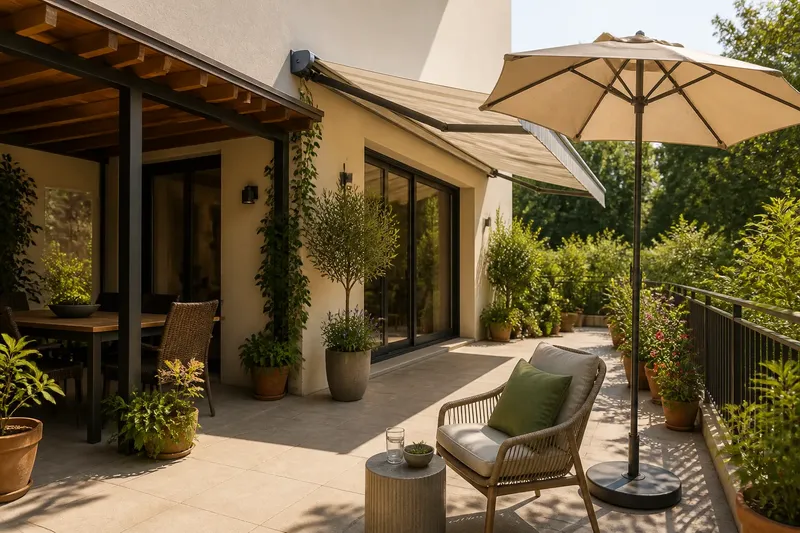
Which outdoor shade suits the spot where you actually sit: a fixed roof, a retractable awning or fabric you can move? The answer depends on where the sun falls, what needs to stay clear and how much you want to adjust the arrangement.
Fixed roofs suit a settled outdoor area
A porch roof or permanent canopy gives a doorway, table or seating area a consistent patch of shade. Because it stays in place, there is no fabric to extend before lunch or put away afterwards. The covered area can feel like an outdoor room, with the edge of the roof defining where people naturally gather.
That same permanence can be a drawback. A roof that shades a breakfast table may leave it in full sun later, while a deep canopy could darken a room or shade plants that need direct light. Before choosing fixed cover, observe the area at the times you use it and look from inside as well as outside. If the shadow falls in the wrong place, the structure will not adjust to correct it.
Fixed shade makes most sense where the same space has a steady purpose, such as shelter beside a doorway or a dining area that remains in one position. It is less adaptable for a rented home, a frequently rearranged terrace or a courtyard where useful seating moves with the sun.
Retractable awnings work best beside the wall
A retractable awning stays attached to the building but can be extended when shade is wanted and drawn back to admit light or open the sky. It suits a regular seating area close to a suitable wall, particularly when the household wants cover at certain times rather than throughout the day.
Its reach is tied to that wall. It may cover a doorway but miss a table set farther out, or fail to shade a corner around the side of the house. The wall, fixings and local requirements also matter. Follow the manufacturer’s instructions for installation, operation and weather limits; if the structure or attachment is uncertain, ask a qualified installer instead of improvising.
An awning is a considered choice when the furniture stays in one place and shade needs to come and go. It is a poor fit if the main task is to move cover between separate parts of a garden or terrace.
Movable fabric follows changing use
A parasol can be repositioned beside a table or chair, while a fabric sail can span an open area if suitable support points are available. Both can provide shade where a roof or wall-mounted awning cannot reach. A parasol is generally easier to shift; a sail requires a planned arrangement of supports and attachments.
Movement has its own demands. A parasol base takes up floor space, and the shade may need repositioning as the sun moves. A sail can pull on its fixing points in adverse weather. Check the product’s care and weather guidance rather than judging fabric by appearance alone. A shade cloth should not be treated as a weatherproof roof unless it is designed for that purpose.
Say a narrow balcony has a chair at its far end, beyond the useful reach of an awning above the door. The starting point is the chair, the balcony’s limited floor space and a need for shade only during sunny spells. A compact parasol is placed beside the chair when needed, then moved aside when the user wants open sky or a clear path. The observable result is that the shaded spot can follow the chair’s use, though the base occupies space and the parasol needs handling.
Check the space before choosing outdoor shade
- Observe where the sun reaches the seating area at the hours you use it. If a fixed roof would shade the right place throughout those periods, consider permanent cover; if the useful patch shifts, choose an adjustable or movable option.
- Check whether the area beside the house is the only place that needs shade. If so, a retractable awning may suit; if the seating is farther away or around a corner, consider a parasol or a suitably supported sail instead.
- Look at the wall and proposed fixing location. If the structure and installation requirements are clear, seek an appropriate awning installation; if they are uncertain, ask a qualified installer or choose a freestanding option that fits the site.
- Check how much floor space a parasol base would occupy. If it leaves a clear route and room for furniture, a movable parasol is an option; if it obstructs movement, consider an overhead solution with suitable supports.
- Identify any plants or indoor rooms that could lose light. If permanent cover would leave them too shaded for their needs, choose retractable or movable shade; otherwise, fixed cover remains possible.
- Read the product’s instructions for wind, rain, operation and storage. If the expected conditions fall within its stated use, proceed on that basis; if not, retract or store it as directed, or select a product designed for the conditions.
What is not worth the effort is searching for one fabric or structure that solves every situation. It is more useful to decide which place needs cover, when it needs it and what must remain open.
Which outdoor shade questions matter before you choose?
Is a fixed awning the same as a retractable awning?
A fixed awning remains extended, while a retractable one can be drawn back to admit light or reveal the sky. Both attach to the building, so the wall and installation requirements matter for either type.
Can a shade sail work on a small patio?
It can, provided the fabric fits the space and suitable support points are available. If the attachments would obstruct movement or crowd the patio, a parasol may be easier to position.
Can outdoor fabric stay up in bad weather?
That depends on the specific product and its instructions, not just how sturdy the fabric looks. Follow the stated limits for wind and rain, and do not assume shade fabric is waterproof.
Let the daily routine decide the final detail
Outdoor shade at home is not only a choice of structure; it is also a decision about what you want the space to do at different moments. A table used for meals, a clear route to the door and plants that need light may all compete for the same patch of ground. Sketching those uses on a simple plan can make the trade-off visible before any fixing or furniture move is made.
When comparing options, keep that plan beside the product details. The right choice is the one that covers the intended seat or table while leaving the paths, light and open sky you still want to use.